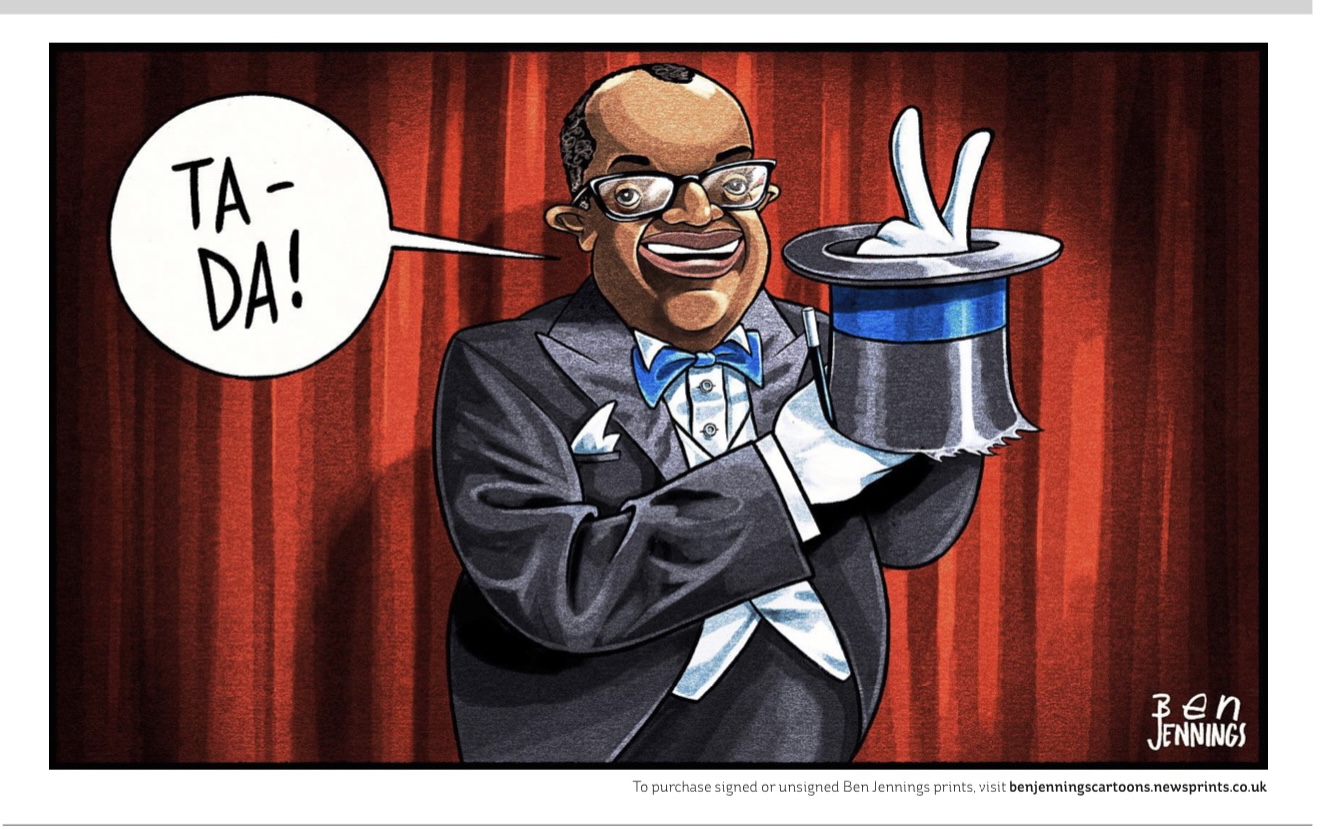
For those of you who might not recognise the guy in the cartoon, he is Kwasi Kwarteng, the UK’s new quasi-Chancellor of the Exchequer, who on Friday delivered what he called a ‘fiscal event’ – in other words, a kind of mini-budget, in the same way that parties in No.10 were known as ‘work events.’ It seems that our government is now working by means of ‘events’: I can’t wait for the ‘oh shit we’ve been voted out event’ to happen. Commentators far more knowledgable than I about economic matters have been queuing up to slam this mini-budget, sorry, farcical event, as being only of benefit to the highest earners in the country, whilst taking a ‘sod you’ approach to the rest of us, and because of its reliance on massive amounts of government borrowing that in all likelihood will tank our economy. Thanks be that we only have to endure two more years of this rabble. Then again, our electorate can’t be trusted to make sensible decisions, can it! But with all of the media interest over the past few days it reminded me that I hadn’t ever chosen this as a theme for this series, so I’m doing it now: this week’s theme is money. I’m taking my usual route, in that some of these will be very familiar to you but at least three of them probably won’t. Welcome to my world!
Several of these selections are, to my mind, fairly obvious choices. So let’s start with one of those, shall we:
Money For Nothing was a track on Dire Straits’ fifth album, Brothers In Arms – yes, that one! This was released in May 1985 and has become one of the most successful albums of all time: it spent 14 weeks at #1 in the UK Albums chart, 9 weeks in the US, and 34 weeks in Australia. Wikipedia’s listings show an unbroken line of #1 for every country they cover, and its sales have been phenomenal: 9m in the US, 4.3m in the UK, over 1m in each of Australia, Canada and France, and more than 30m world-wide. Five of its nine tracks were released as singles, all of them making the UK singles chart. This was the second, in June 1985, and it got to #1 in the US and Canada, and #4 in the UK. The intro vocals and some of the back up were provided by the distinctive voice of Sting, who performed with the band during their appearance at Live Aid in 1985. The video was also the first to be played on MTV Europe at its launch in 1987. Overall, a pretty good track record!
While I’m in the mood to give you something obvious, here’s another:
ABBA released Money Money Money on their fourth album, Arrival, in October 1976. It reached #1 in the UK, Australia, their native Sweden and several other countries but, in keeping with their chart performances over there, only got to #20 in the US. It didn’t do badly for US sales though: over 500k, compared with 1.7m in the UK. This was the second single from the album, in November 1976, and it reached #3 in the UK but only #56 in the US. Something of a flop by their standards? Hardly – it was #1 in several countries, and sold more than 3m copies worldwide in addition to the album’s sales. Regular readers might be surprised to see me venturing into the pop charts like this, but ABBA were difficult to ignore: their records were insanely catchy, and they featured two of the most beautiful women ever to be in a pop group, so what’s not to like? Mind you, with all the money money money they made you’d think they could have afforded not to dress in their pyjamas for that video, wouldn’t you?
There are several AC/DC songs which include the word money in their title, so they were always going to be a likely choice for me. But which one? I decided to go for one of the lesser known and, to stretch things a little further, I’m playing a cover version of it:
Steve ‘n’ Seagulls are a kind of bluegrass band – they call it ‘newgrass’ – from the hotbed of that style of music, er, Finland. They have made many covers of AC/DC songs, with some funny videos. By their standards this one is a little more restrained, but it still includes some nice touches: the door handle breaking off, for example, and the driver tapping along on his steering wheel in time to the beat. They are a fun find on YouTube and I can recommend them if you enjoyed this one. They have to date released four albums which generally reflect their rustic background in their titles: Farm Machine, Brothers In Farms (brilliant!), Grainsville and the most recent, Another Miracle, in 2020, from which this track comes. The original of Moneytalks was on AC/DC’s album The Razors Edge, released in September 1990, which reached #2 in the US and #4 in the UK. It got to #1 in Finland, though – I spy a connection! Their version was released as a single, making #36 in the UK and #23 in the US.
While I’m in bluegrass territory, how about another:
This is a fairly recent release, from an album called Jerry Jeff, released in May this year. The album is a tribute to Jerry Jeff Walker, a renowned US country and folk singer-songwriter, who died in October 2020. He is probably best known for having written the song Mr. Bojangles, which has been covered by the Nitty Gritty Dirt Band and Bob Dylan, among others. Now including Steve Earle too, of course.
Back on what might be more familiar territory for many, now:
Readers of my vintage, and rock music fans of any age, probably won’t need reminding that Pink Floyd released Money on their album Dark Side Of The Moon in March 1973. The album is one of the best sellers ever, though it bears the dubious distinction of being the biggest in the UK, with over 4.5m copies, that failed to ever reach #1 here, though it has spent 544 weeks in our charts. It peaked at #2, but topped the charts in the US and many other countries, selling over 45m copies worldwide and leaving even Dire Straits trailing in their wake.
From one extreme of sales to the other now. The video clip cuts off the first second or two but at least it is in sync, which is more than can be said for the other copy I found:
This was the title track of Gerry Rafferty’s first solo album, as the video tells us. It was released in 1971 but did absolutely nothing in chart terms. I bought the album at that time and loved it – I still do. It was a critical success but Gerry had to await chart entries until he formed the band Stealers Wheel with Joe Egan (Stuck In The Middle With You), and then his solo success with the City To City album and the Baker Street single. I always felt this album deserved better: it is a little gem with some great songs, including the achingly beautiful Mary Skeffington, which I’ve played before. In case you were wondering (and even if you weren’t) I don’t know who the fiddle player in this performance is. A guy called Johnny Van Derrick was credited on the record, but as he was bald and would have been 45 at the time of this I don’t think that can be him. Whoever he is, he did a great job! Some of the song’s lyrics are still just as relevant today as they were over fifty years ago, especially the bit about politicians.
Today’s penultimate tune is another cover version. Rather a unique one, in fact:
This song was co-written by Berry Gordy and was first recorded by Barrett Strong. It became the first hit for Gordy’s Tamla Motown label, reaching #23 in the US in June 1960, ten months after it was first released. Among the many cover versions are those by The Beatles and The Rolling Stones. And then there was this one. The Flying Lizards version of Money was released in July 1979 as a single and as a track on their debut album, The Flying Lizards (imaginative title). The album peaked at #60 in the UK and #99 in the US but this song became an unlikely hit here, getting to #5. It also made #50 in the US. They were known as an ‘experimental new wave’ band, and Wikipedia describes this track as ‘eccentric.’ I wouldn’t argue, but I’ve always rather liked it because of that weirdness. The vocalist on this was Deborah Evans-Stickland. She was been asked why she spoke the lyrics, and her response is a piece of classic simplicity: “singing is more difficult.” That first album includes their version of Eddie Cochran’s Summertime Blues, and it may come as no surprise to you that it was as odd as this! I can’t resist adding in a bonus video which is part of a 2015 BBC documentary – it is four minutes or so about their remake of the song, and includes that lovely piece of logic from Deborah:
Back on more familiar territory for today’s final offering. Again, this one may not come as a surprise to anyone who has seen my posts before:
I did actually play this one about five months ago in this series, but I like it so much I thought I’d give it another airing, and this is a great live performance – the drummer is fantastic, and just wait till Cyndi goes into orbit! Money Changes Everything was the opening track on Cyndi Lauper’s debut album, She’s So Unusual, which was released in October 1983 and got to #4 in the US and #16 in the UK, though it did make #1 in Canada and Zimbabwe. The album has been hugely successful and has to date sold more than 6m copies in the US and 16m worldwide. I bought it at the time and have always liked it – the first side, in particular, is incredibly good. This was the fifth of the album’s six tracks to be released as a single, in December 1984. It reached #27 in the US but didn’t make the UK charts – I guess we’d all bought the album by then. Hopefully her royalties were enough to buy a matching pair of shoes, though.
That’s all for this week. I have several more possibilities for this theme, and I think it might still be relevant as a response to the news by this time next week, so who knows what I’ll be playing? I certainly don’t. Enjoy your week and, if you’re British, enjoy the spectacle of your government disappearing up its own fundament as a consequence of its own stupidity. Take care 😊🎶
 Take It Easy