
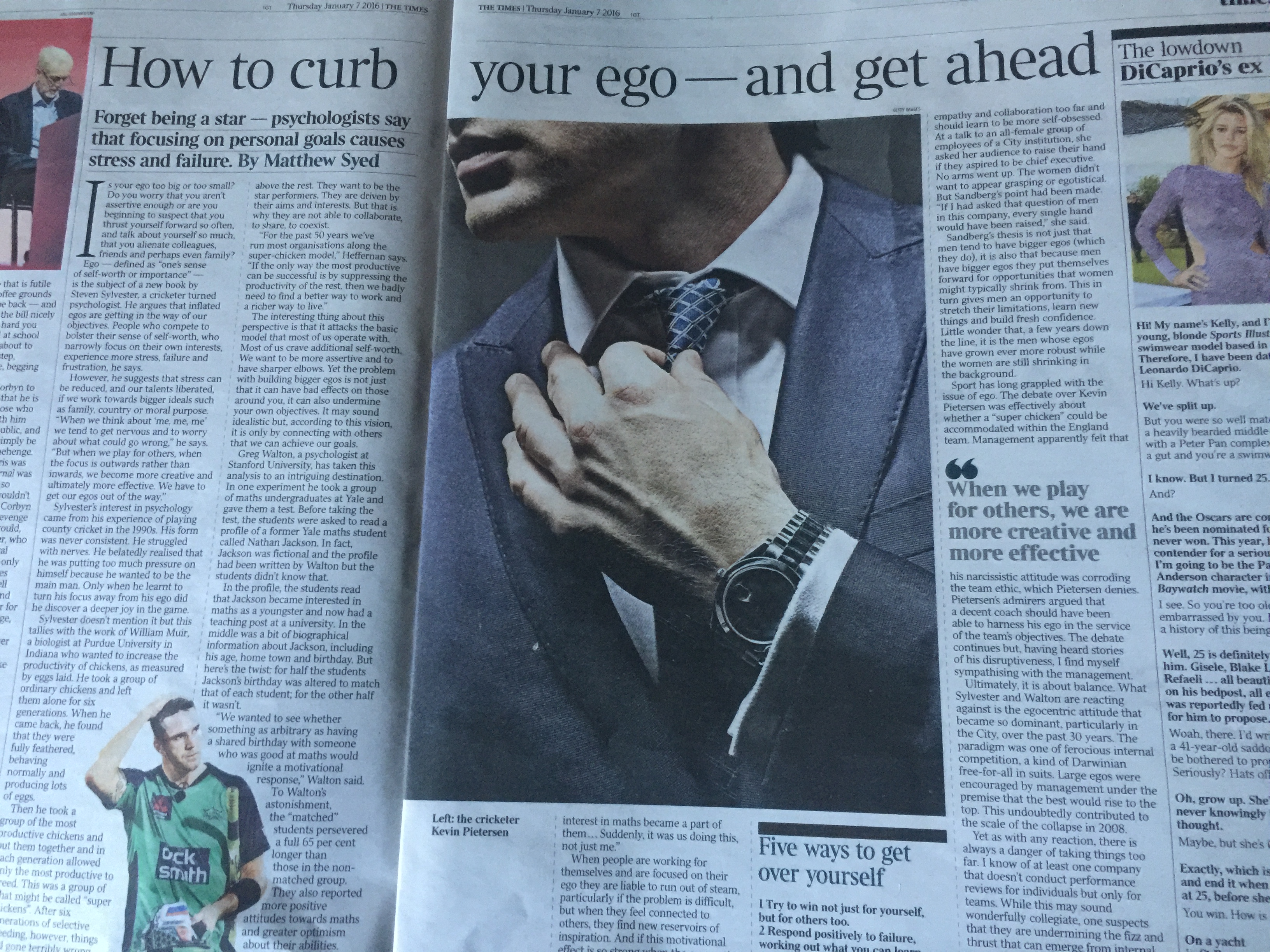
From The Times, 7 Jan
A couple of days after I posted Goals there was an article in The Times about some recent research into the effects of goal-setting, egos and ambitions. This was clearly a coincidence but it got me thinking further on this subject.
In that post I recognised that not everyone would agree with me, and was clear that I would have no 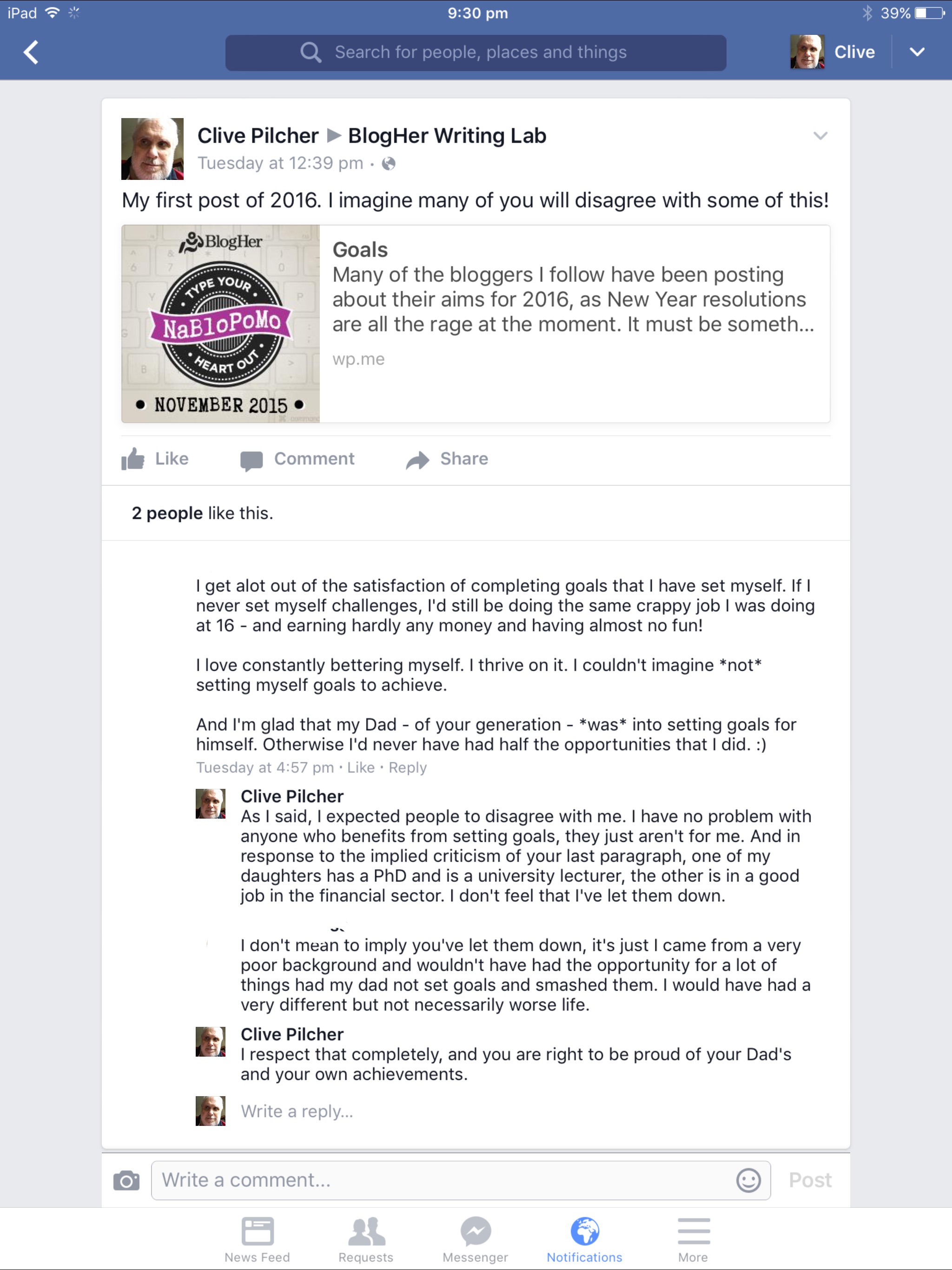 problem with that. No one who has commented here has disagreed but I did get one dissenter on Facebook, presumably after I shared the post with the BlogHer Writing Lab. This wasn’t someone I know, but she took issue with my comment about this being a generational thing and made some valid points about the impact on her life that had been achieved by following her father’s approach to goal-setting. As I said before, I know that this is important for many people – indeed, goals played an important part in my working life too. I’ve anonymised the conversation but am showing it here so that you can see what I mean. I have no quarrel with anything this young woman said, but I read her comments on the same day as the newspaper article and they made an interesting juxtaposition.
The Times’ article was written by Matthew Syed, a respected sports and features reporter, who in a previous life was an international table tennis player: this experience gives him a good standpoint from which to judge the research on which he was writing. It took as its starting point a new book by Steven Sylvester, entitled Detox Your Ego, and brings in research from Yale and Purdue Universities in the US into the relationship between personal ego/goals and collective achievement. The conclusion drawn in the research was that when people are working solely for themselves and are focused on their own ego they are likely to run out of steam, especially if their problem is difficult, but when they feel connected to others they find new reservoirs of inspiration. The article goes on to argue that suppression of ego is more common in women than in men, and that this is at least in part an explanation for the lack of female candidates attempting to break through the so-called glass ceiling. Syed concludes that there should be a balance between the individual and the collective, as we all welcome the chance to shine now and then.
I accept that a balance is necessary. What I was saying before was that goals have no place in my life as it is now. That is not to say that they have never been there, but I accept that I have always been much less goal-driven than others – which could partly explain why an old schoolfriend received a knighthood in the New Year’s Honours and I’m never even likely to get on the bottom rung of the Honours scale. They aren’t for me, anyway! I also have an ego – we all do, like it or not – and can be very competitive in some things: playing board games and, in my younger days, playing sport, for example. But I’ve always felt that I did my best work as part of a team, in recognising the collective goal and subjugating my own ego to that. I’m now beginning to wonder if this means that I am weak, that in some way I do not have any individual value. But that is rubbish, isn’t it? We all have our merits, however they manifest themselves. The fact that I preferred to pool my skills with others when I was in a work environment is a recognition of that value, not a denial of it. I did exactly what the research has shown was the best way to succeed, I think. The young woman I mentioned earlier evidences how someone can use goal-setting to their advantage: I, on the other hand, managed to achieve a reasonably successful career by another route. Is this any less valid? I think not: it’s a classic case of “different strokes for different folks.” And we are never too old to learn a new way or to change: I want to expand my writing, and have accepted that this is something which can only be done on my own. Yes, writers can collaborate but I know that wouldn’t work for me! But that doesn’t mean that I have to work on it to a target, or to set myself goals and bring on the pressures and pains that come with them.
A further aspect of the research quoted in Syed’s article is the stress that can be caused by focusing on goals, on feeding the ego. This is really the crux of the issue for me. In my current life phase I have no need of stress. I recognise how it has damaged me as a person in the past, how it contributed to my depression and, I believe, to the breakdown of my marriage, at least in part. Putting pressure on oneself to achieve goals, both in work and personal contexts, can of course enhance performance and achievement. But it must have a counterbalance. Focusing on ourselves does, almost by definition, mean that we are excluding the goals, hopes and ambitions of others from our thought processes. If those people are work colleagues or life partners how damaging can that be to a successful working or personal relationship? To my mind, there is nothing wrong with having personal goals and ambitions, providing that they are not to the exclusion of others or, even worse, that their achievement requires others to be trampled on along the way. And I reserve the right to choose whether I want to set any for myself.

The Times, 12 Jan
Today’s lead news story in The Times is a call by our Prime Minister for all mums to be ‘tiger mums,’ a reference to Battle Hymn Of The Tiger Mother, by Amy Chua, which was published in 2011. This book outlines the author’s childhood and the parental pressure that was placed on her to succeed, and commends this as a model for all. But it is one thing to accept, as I do, that schooling should include competitive sport as a life and character builder, and that a ‘prizes for everyone’ culture is meaningless: but this falls a long way short of promoting a culture in which everyone, from a young age, is subjected to pressure to achieve. Not surprisingly, the book’s model has been criticised by many as being damaging to child mental health, as there is abundant evidence to show that harsh parenting can lead to depression and low self-esteem in children, which can remain with them throughout their lives. Some people thrive under pressure, others don’t. The best managers – like Sir Alex Ferguson – know how to treat each individual differently to get them to achieve their best both as individuals and as part of a team. But the Prime Minister wants all mums (Sexist? Don’t dads have a role to play?) to follow the high pressure, tough parenting approach. Will we never learn? The treadmill is continuing to revolve!
 Take It Easy