Most are probably familiar with the phrase ‘lies, damned lies, and statistics’ which was attributed by Mark Twain to the British Prime Minister, Benjamin Disraeli, though that is open to debate. No matter, though. What you take from statistics is, to a degree, a subjective judgement, and you can find copious examples of data being interpreted to make a point, when others have made something completely different from the same material. The same creative subjectivity has always been true of politicians, but it seems to be an ever-increasing political currency.
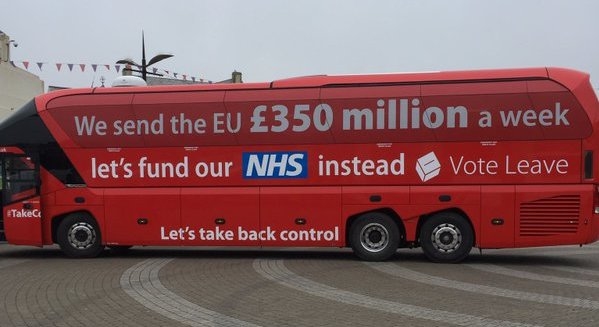 In the UK our referendum vote on whether to leave the European Union was based, to my eyes, on two key factors. One was the nebulous phrases ‘let’s take back control’ and ‘taking our country back,’ which with the help of the right-wing press gradually morphed into a kind of racist distrust of anything and anyone ‘foreign.’ The other was the assertion that every week the UK kindly donated £350m to the EU, and that this sum of money could be far better spent on our National Health Service. They even plastered this all over a bus, in case we didn’t get the message clearly enough.
The recent US Presidential election was seemingly won on another nebulous phrase, in this case ‘make America great again.’ Define ‘great.’ Define when you think America was ‘great’ and what it might mean to take the country back to that time. Get my drift? I would also point to parallels to our £350m bus, but there were so many that we could be here quite some time.
One thing was common to both elections. The morning after our referendum, Nigel Farage – largely regarded as a racist clown jumping on the coat tails of real politicians – proved his credentials by saying that the £350m figure wasn’t really a promise, but had just been used as an illustration of what a post-EU Britain might look like. Yeah, right. Since ‘call me Mr Brexit’ won the US Presidency, his team have begun to disassociate him from some of his more extreme promises, describing them as just ‘campaign talk.’
Do they really think that we are so stupid that we don’t see these statements for what they are? Sadly, given the results, it appears that they do – and we are. But I’m not stupid. So, just to be clear, dear politicians, these aren’t illustrations or campaign talk: they are LIES. Big, bold, fat, pants on fire LIES.
Why do politicians need to lie to get what they want? Are their genuinely held beliefs so odd that we wouldn’t vote for them if they told us the truth? Let’s face it, some of the stuff Trump said during his campaign was so outrageously racist, misogynist, homophobic and xenophobic that if his real opinions are watered-down versions of these they are still pretty distasteful. But he found enough people willing to give him a chance. Both election results were seen as protest votes against the status quo, against politicians who had lost touch with the people they represented. That is probably true, but if the alternative is lies then I don’t want it.
Do real people, those who voted in these elections, base their lives on lies? I guess some do, but that isn’t my way. I believe in being honest and truthful, in being taken for who I am. You may not like me, but that’s your right and I accept that. But I could never live my life by lies: I have a conscience, and it would destroy me from within if I tried to do that. I have a conscience which prevents me from telling lies to get what I want. I have a conscience which prevents me from telling more lies – ‘I didn’t say that’ – when challenged on what I have said and done. I’m probably being naïve, but if politicians started to tell the truth they would be much more likely to get my vote. You can always tell when a politician is lying – it is when their lips are moving. It’s time for some truth and honesty. But the cynic in me says that it won’t happen. Over to you, politicians: prove me wrong.

