For this week’s Song Lyric Sunday, as he tells us in his post – Groundhog Day – Jim is inviting us to play a song about being stuck, feeling trapped, or about regret. I had decided on a couple of tunes for this, but then on Thursday the sad news of Marianne Faithfull’s passing came through. I at once felt that I should change my selection and devote today’s selection to her memory. For those of you who follow her you may already have seen Willow’s tribute post to Marianne, on which I commented that she had done such a good job with it that I thought I should have a second rethink! To her credit Willow encouraged me to stick with it, so that’s what I’m doing, and she is going for it again today too, adding to a fitting tribute to a great singer. I’m not sure that I can add much to what Willow has said, but Marianne deserves to be remembered.
I’m playing four songs from Marianne today, all of which fit the theme very well. I just have to start with this one:
And here are the lyrics, which you probably already know anyway:
It is the evening of the day
I sit and watch the children play
Smiling faces I can see
But not for me
I sit and watch
As tears go by
My riches can’t buy everything
I want to hear the children sing
All I hear is the sound
Of rain falling on the ground
I sit and watch
As tears go by
It is the evening of the day
I sit and watch the children play
Doing things I used to do
They think are new
I sit and watch
As tears go by
Songwriters: Andrew Loog Oldham, Mick Jagger, Keith Richards
Lyrics from genius.com
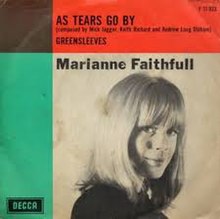
As Tears Go By was Marianne’s debut single when she was just 17, released in June 1964, and it peaked at #9 in the UK and #22 in the US. It also featured on her eponymous debut album, which came out in April 1965 and got to #15 in the UK and #12 in the US. It is very much a song about regrets, making it perfect for today’s theme, and I’ve always loved both Marianne’s version and the one recorded by The Rolling Stones: both equally lovely in their own ways.
At the time her pop career was beginning we got to learn a lot about Marianne from our local newspaper – the Dover Express. Why the interest? I was born and brought up in Dover – the real one, in Kent, England – and her uncle was a General Practitioner in the town. The local rag latched onto this pretty quickly and we were regularly treated to updates on what she was doing, even though I think that was her only tenuous connection to the town: she never lived there, as far as I know, and probably only came for occasional family visits when she was younger.
Back to the music. Here’s another for which she was well known:
The Ballad Of Lucy Jordan was a track on what is probably Marianne’s best known album, Broken English, which was released in November 1979. She was always eclectic in her choices of songs to cover, and this one was no exception: it was written by Shel Silverstein and was first recorded in 1974 by Dr Hook and the Medicine Show (Willow is playing that version today, too). In Marianne’s hands it became a more tragic reflection on a life of wasted hopes and dreams, which at the time was very much a metaphor for regrets in her own life. After her initial pop success she had by then gone through her first two (of three) marriages, three miscarriages, and four abortions. The first of those was in 1965, when she had become pregnant by Gene Pitney: the procedure was still illegal in the UK at the time and she has said that it was hard for her to deal with the guilt. She began to feel better once her son was born the following year. Subsequent terminations were from her period of drug abuse, as she did not want her children to be born as addicts: she had become addicted to heroin and had spent two years homeless in London, so the success of that album was very welcome. This track was released as a single in late October 1979, a few days ahead of the album, and made #48 in the UK. The album only got to #57 in the UK and #82 in the US, but was a big hit in Europe, peaking at #3 in Austria and France, #4 in Sweden and Germany, but did best in New Zealand, where it got to #2.
Marianne’s first album included a cover of a Beatles song, and she returned to one of them for a later album, with another song about being in a lonely place and needing support. I would imagine that this song meant a lot to her:
As you probably know, Beware Of Darkness was a track on George Harrison’s epic triple album All Things Must Pass, which was released in 1970. As the video clip shows, this was a track on Marianne’s album Rich Kid Blues, which came out in 1985. The tracks on this were actually recorded back in 1971 but the record company declined to release the album – Masque, as it was to have been known – and it only saw the light of day when her new label released it following the comeback success of Broken English. I said she chose her covers well: this album included songs by Bob Dylan, Cat Stevens, James Taylor, Sandy Denny, and Tim Hardin, as well as this one. I rather like the soft, breathy vocal treatment she gives the song.
I normally restrict my SLS posts to a maximum of three songs but, as this is by way of tribute, I’m breaking my own rule and playing you a fourth to close out. This one goes back to her early days and is another cover version, of a song that deals with the depression and feelings of being trapped which can follow a break up:
Is This What I Get For Loving You? was written by Phil Spector, Gerry Goffin and Carole King and was first recorded in 1965 by The Ronettes. By then their career was in decline and their version only made #75 in the US. Marianne’s version came out in February 1967, as a non-album single, though as the clip shows it has since been on compilation albums. She did rather better with it, peaking at #43 in the UK and #42 in Australia, though only #125 in the US. It is very much a song of its time, but is still a good fit for today’s theme.
There is much more I could tell of Marianne’s life, of the various illnesses from which she suffered, the several times that these got in the way of her career and forced tours to be cancelled, her acting career and the movies she was in, and I’ve so far managed to get through without mentioning her various love affairs, the most famous (notorious?) of which was with Mick Jagger from 1966 to 1970 (remember the ‘naked behind a rug’ drugs bust?). But I want to leave you enjoying the music of a woman who overcame so much and became a star. That star may have gone out, but it still burns brightly for me with the musical legacy she has left us.

