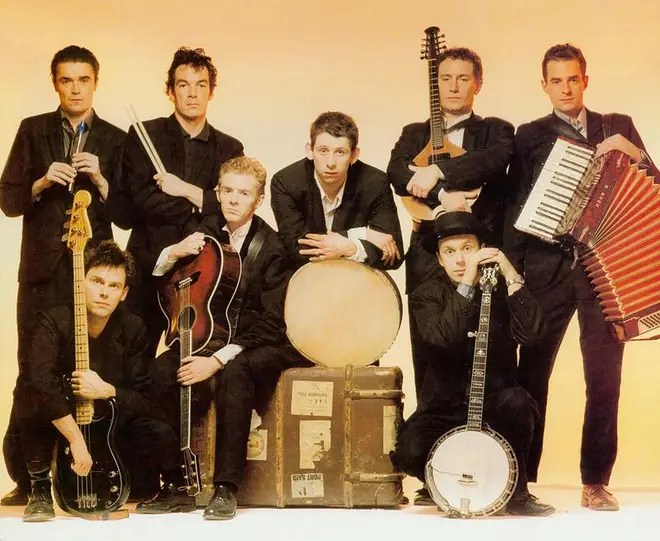
I call Listen To The Band one of my occasional series. The last one was in August of last year, and the one before that in September 2022, so I think I’m living up to the description. I have been meaning to do one of my tribute pieces for Shane MacGowan since he passed away at the end of November, but never quite got round to it. This is by way of my tribute, and it is an excuse to play some music by a band I’ve always enjoyed.
The Pogues formed in 1982 out of a string of bands that the founder members had been in. They were influential in bringing a punk style to Irish music, and were very successful both here and in Ireland, though less so in the US – forgive me, American readers, but at least you’ll know what you were missing out on. They took their original name ‘Pogue Mahone’ from the Anglicised version of a Gaelic phrase which translates as ‘kiss my arse,’ but once they started becoming popular their record company persuaded them to change it – though they did bring it back as the title of their final album. For such an ‘Irish’ band it may come as a surprise that of their original six member line up only one – Shane – was actually Irish, and even he was born in England to Irish parents. The others were all English, but that didn’t stop them becoming hugely popular in their ‘homeland.’ They were also successful in several other European countries and, to a lesser extent, in Australia and New Zealand. In their time they released seven albums, five of which included Shane as lead vocalist, before he left the band in 1991.
I’m going to be playing a random selection of songs that I enjoy, in no particular order. This first one is a collaboration with The Dubliners, which was actually on a Dubliners album, 25 Years Celebration. It was released as a single in 1987, topping the Irish charts and peaking at #8 in the UK:
If you weren’t awake before that, I guess you are now! The Irish Rover is, as I’m sure you know, a traditional Irish folk song. The Pogues drew a lot on tradition for their records, as well as writing many of their own songs. They also recorded some cover versions, sometimes of songs which had also been recorded by The Dubliners, like this one:
Dirty Old Town was written in 1949 by the American folk singer, Ewan MacColl, and has been recorded many times, including the Dubliners’ version in 1968. The Pogues’ version was on their second album, Rum Sodomy And The Lash, which was released in August 1985, making #13 in the UK and #17 in New Zealand. This track was released as a single that same month, peaking at #27 in Ireland and #62 in the UK, though it has been a steady seller here and has achieved a silver disc for 200k sales.
Time for one of the band’s own compositions now. This one, written by Shane, was on their Hells Ditch album, the last one he made with them. I’ve played this song before as part of a Tuesday Tunes set, but I like it a lot so you’re getting it again! As this is an album track there isn’t an official video for it, but I’ve found this one which takes a nice trawl through their concert history
The album reached #12 in the UK, and also made #17 in Sweden, and has received a silver disc here for 60k sales. Rain Street wasn’t released as a single – I think it should have been.
As I said, there is no particular order to these songs. This next one was written by one of the other band members, Philip Chevron, who had joined the band in 1985 and was actually Irish. It featured on their third album, If I Should Fall From Grace With God:
To my mind, that video is a very good fit for the meaning of Thousands Are Sailing. The song opens by setting its place and tone: “The island, it is silent now….” The torch referred to is that of the Statue of Liberty, and “the island” is Ellis Island, where the federal immigration station opened on 1 January 1892 and was closed in 1954, having processed twelve million immigrants. This is a powerful retelling of history, as there was a documented 30% mortality rate on those ships, which gave rise to them being called ‘coffin ships.’ The final chorus references the conflicted feelings of Irish emigrants – “where’er we go we celebrate the land that makes us refugees” – and is still sadly so relevant today. The album reached #3 in the UK, #4 in New Zealand, #9 in both Sweden and Switzerland, and was their first to make the US Albums Chart, where it got to #88. For some reason Wikipedia doesn’t include Ireland in its list of countries for The Pogues’ albums discography, but I think it a safe bet that this one sold well in Ireland too, as its three singles reached #1, #4 and #11 there.
From the opening bars you might think this is going to be another track from that album. It is, but possibly not the one you were expecting:
The Broad Majestic Shannon was written by Shane, and as far as I can tell is a song addressed to a former lover. It is slightly ambiguous, I think, as to whether they simply broke up or whether she had died, but the lyrics are lovely whichever way you read them. There are many references to Irish locations near where his parents came from, and I think it likely that much of this one is nostalgia for places he visited with his family whilst on holiday there during his childhood.
I’m going back to Hells Ditch for this next one, another of Shane’s songs, co-written with Jem Finer who played banjo, amongst several instruments:
Wikipedia describes Sunny Side Of The Street as being ‘an up-tempo celebration of an unrepentant libertine’ – a common theme for Shane. They also say that it made #23 on one of the US’ Airplay charts, though they don’t record it as having been released as a single. Either way, I’ve always liked it and think it was a great way to start an album.
I’m aware that I have only featured three of the five albums on which Shane played with the band: that doesn’t mean I don’t like the others, it is just that my favourite Pogues songs aren’t on them. I’m closing with the obvious one, even though it is out of season. This one also appeared on the If I Should Fall From Grace With God album, and has become incredibly well known from its success as a hit single. In its original recorded version the duet was shared with Kirsty MacColl (daughter of Ewan – see above), but for live performances the band had to think of something else, even before Kirsty’s tragic death in December 2000. I’ve seen Shane sing the song with Camille O’Sullivan, as guests of the Sharon Shannon Band, and Camille did a great job with it. For live performances the female part was often taken by Ella Finer, daughter of Jem, who co-wrote the song with Shane. She does her Dad proud, in this 2012 performance from Paris:
I think there is something in my eye. One of the comments on that video on YouTube remarks how moved Ella seemed to be that she was a part of this, and I think that is right: she does look close to tears a couple of times, especially after that closing dance, and this is another of the reasons why I love music so much.
Shane has left us a great legacy of music, and I celebrate his memory.

