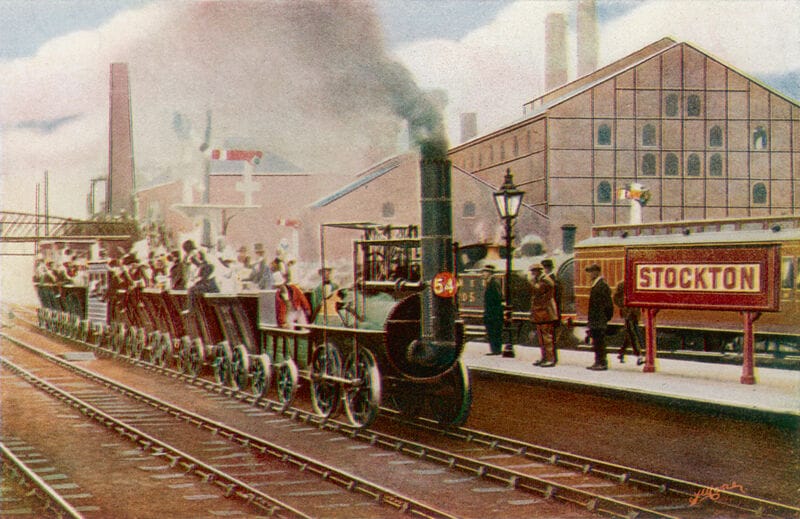
This year sees the 200th anniversary of the UK’s first public rail passenger service driven by steam engines: the Stockton and Darlington Railway, in the north east of England, which began operations in 1825. There had been ‘train’ services before, notably in south Wales from 1807, but those were horse-drawn and were soon superseded in the time of the Industrial Revolution.
Amongst many events to mark the bicentenary, under the Railway 200 banner, BBC Radio 2 has devoted some of its folk music programming to share some newly commissioned songs, all of which tell a story of people connected in some way to the railways. Regular readers will know that I have a huge love for folk music, and in particular for the way it tells stories of everyday life. Many such songs have been handed down through the ages, but this series comprises tunes especially written. There have been five of them, and I thought I’d share three with you, with their background stories. The beautiful thing about these songs and videos is that they were recorded in the presence of the people whose stories had inspired them, so be warned: you may need a tissue handy for a couple of them.
The first one I’m sharing is about a chap called Tom, who is a railway station foundling. The BBC tell us that in 1965, as a two-week old baby, he was found in the ladies’ waiting room of Reading railway station in Berkshire. He had been born out of wedlock to an Irish family, and his birth mother, knowing that she couldn’t bring him up, left him well-dressed and tucked under a bench with a spare nappy and bottle. He was brought up in a loving family home and had a happy childhood, and discovered more about his story much later in his life. He now lives in Nottingham. Singer-songwriters, Chris While and Julie Matthews, from Sheffield in South Yorkshire, are Britain’s longest-enduring female duo having performed together for over 30 years. They have played more than 2,500 gigs and appeared on more than 100 albums, and this is The Waiting Room, the song they wrote for him:
I said tissues might be needed, didn’t I. A beautiful song taking the perspectives of Tom’s birth mother and her regrets at having to leave him, and then his adopted mother and her love for him. Tom and his wife were visibly moved by it.
Regular readers will also know that I am a huge fan of Richard Thompson, possibly the best singer-songwriter this country has ever produced. His song is about a guy called Siggy, who lives in Hampstead, London and is part of the Windrush generation. The 85-year-old came to the UK from Barbados in 1962 and became a railway worker the day he arrived. He still loves his shift in Customer Services at Elstree & Borehamwood station and previously played cricket for the England over-70s, as indeed has one of my old schoolfriends, though more recently than Siggy. This performance of Siggy’s Song offers thanks to Siggy’s teammates at Holtwhites-Trinibis Cricket Club in Enfield, and much fun was had by all:
That is so much fun to watch, and I love the way everyone joins in to honour Siggy. If you don’t know what the Windrush generation is, this page from the official UK Government website gives a good background to it. People like Siggy were hugely important in helping our country to rebuild after the Second World War and they have been treated scandalously.
The final one I’m playing is a real tearjerker. The song is by another of my favourites, Kate Rusby, and tells the story of Charlotte, who was undergoing a mental health crisis and was beside a train track intending to take her own life when David, a train driver, got out of his cab and spoke to her until she felt able to board the train. She later contacted him to say thank you, they started dating and are now married with children, and live near Bradford, West Yorkshire. Light Beyond The Lines tells their story, and is performed by Kate and her husband, Damien O’Kane:
I often hear people say that they don’t like folk music and would much prefer to listen to pop and soul, for example. I think that is very narrow-minded: folk music is real life, it tells stories in a way that no other genre does, and has been the way that we have learned about events for centuries. If you don’t appreciate that I can only say that I’m sorry for you, as you are missing out on so much. I hope these three songs might have opened your eyes and ears a little: had you ever heard the stories before? I hadn’t, and I think they all deserve to be known. Somehow, I don’t think Motown would have worked for them!
I’ll see you again for Song Lyric Sunday, I trust. I’m off to buy a couple of things for my new granddaughter and her parents: they finally left hospital yesterday, and we are all thrilled. I wonder if Kate Rusby could be persuaded to write a song for her…
Take care 🩷


Pingback: My August | Take It Easy
I did know about the settlers in the UK from the Caribbean but I didn’t know they were called the windrush generation. Thanks for including the Government page. The song about The Waiting Room is very moving. Such a sad situation. I remember reading once that during Dickon’s time (the Victorian era) the streets of London were littered with the corpses of dead infants due to abandonment by single mothers. Queen Victoria singlehandedly encouraged this situation with her Poor Law Amendment Act of 1834.
LikeLiked by 1 person
I thought that background might be helpful. They have been badly treated for many years, culminating in the last Conservative government removing their British citizenship in 2017 for many of them.
That is a really lovely song, isn’t it, and very moving for its subject.
Dickens wrote Oliver Twist as his protest about conditions for the poor, but don’t blame Victoria for it! She was only 15 when the law came into force and didn’t become Queen for a further three years, so I don’t think she could have had much influence: we were well down the path of a constitutional monarchy by then anyway.
LikeLike
I enjoyed this post and the history of GB rails and adoptee, Tom. We adopted 2 abandoned children who were also left where they could be found. from 373 Senior Salon Pit Stop #48. 50, 51
LikeLiked by 1 person
Thank you, I’m pleased you enjoyed these stories, and that they had personal meaning for you.
LikeLike
Pingback: 🧵🧶🪡TIERNEY CREATES🪡 🧶🧵 | PRIORHOUSE INTERVIEW August 10th, 2025 – priorhouse blog
I loved all these songs! They were each perfect in their own way. I am a fan of folk music, too and love songs that tell a story. Great post, Clive!
LikeLiked by 1 person
Thank you, Lisa, I’m pleased you enjoyed these and are a folk fan too.
LikeLiked by 1 person
A lovely trio of songs. Trains figure in so much music and many stories as if trains and stations were just made for stories real and fiction. I had not heard of theses stories before, but now I will remember them.
LikeLiked by 1 person
They are lovely, aren’t they. I’m pleased you liked them. And maybe there’s a Tuesday Tunes theme in this 😉
LikeLiked by 1 person
so glad the baby left the hospital – woo hoo
and enjoyed this post and Siggy’s song and The Waiting Room really made my night
LikeLiked by 1 person
Thank you, that’s kind of you. We’re all thrilled!
And I’m glad you enjoyed these. It was a nice post for me too.
LikeLiked by 1 person
😉
LikeLiked by 1 person
Three fine celebrations of lives that might not have turned out so well.
Now, go out and blow that bank balance!
LikeLiked by 1 person
They are indeed, aren’t they.
It’s been done!
LikeLiked by 1 person
Pingback: People And Trains - Woman enabled
That first selection was deliciously heartbreaking but oh so worth it ☺️
LikeLiked by 1 person
That one is pretty special, isn’t it. Three very good songs, and the songwriters clearly spent time with their subjects while they were writing them.
LikeLiked by 1 person
I don’t know how widely known Kate Rusby is outside the UK, I remember hearing about her in the 90s. She’s a talent for sure.
LikeLiked by 1 person
I doubt if she’s known much anywhere else. She tours and plays festivals here, but I get the impression that since she had her daughters she devotes her time to them and her music. A home bird! I’ve seen her in concert and she is amazing. A beautiful voice and a charming person.
LikeLiked by 1 person
A lovely post and funnily enough I had heard these songs and stories on the BBC… I must have caught a programme on the radio or iPlayer. .
Beautiful post Clive and I agree about folk music it is very important to our way of life and history. 💜😊
LikeLiked by 1 person
Thank you, Willow, I’m pleased you enjoyed it. I rarely listen to the radio and caught up with these on YouTube, but will probably listen to the show on BBC Sounds at some point.
I couldn’t resist that little moan, as it always disappoints me when someone knocks folk music – it is our history!
LikeLiked by 1 person
Oh! I agree I love all folk music from anywhere but especially English and Celtic. I also agree and though I know we can’t all love everything we should never dismiss anything out of hand and especially not our amazing heritage 💜💜💜
LikeLiked by 1 person
I completely agree with you. Those are also my two favourites but you’ll have seen several German and Russian ones on my blog over the years too. Even some of what Americans call ‘folk,’ though much of it doesn’t fit my definition of the genre!
LikeLiked by 1 person
American folk is sometimes good it’s just not old enough is it 💜💜💜
LikeLiked by 1 person
It goes back to around 1850, much later than here. I see it as meaning the likes of Woody Guthrie and Pete Seeger, not the more mainstream acts that for me should be called ‘singer-songwriters.’ They think Peter Paul and Mary are folk – I don’t.
LikeLiked by 1 person
No not quite sure where where to plant them 💜💜
LikeLiked by 1 person
I love folks songs and the stories they tell. These are all wonderful. Have fun shopping for the new grandbaby!
LikeLiked by 1 person
Thank you, Darlene, I’m pleased you enjoyed them. That’s the beauty of folk music for me too.
Shopping has been undertaken, and no doubt there will be much more 😉
LikeLiked by 1 person
Glorious songs that really stir the emotions. Clive, you chose the perfect songs to demonstrate the power of music and lyrics. Each one told an incredible story set to a lovely, poignant melody. Heartfelt tunes, wonderful choices. ❤️
LikeLiked by 1 person
Thank you, Nancy, I’m pleased you liked these. They really do tell their stories so well, don’t they.
LikeLiked by 1 person
Absolutely! My favorite was “The Waiting Room”. Chris & Julie’s beautiful blend reminded me of Simon & Garfunkel.
LikeLiked by 1 person
That’s a really beautiful song. They’ve been singing together for many years and it shows, doesn’t it.
LikeLiked by 1 person
You can’t beat a bit of Folk music.so much history gas been carried this way. CAN’T knock Motown though as it also carries a story and a great depth of emotion through it’s lyrics. Hugs
LikeLiked by 1 person
You have the good taste to like both styles, David. Sadly, others knock folk music and I couldn’t resist that little dig 🤣
LikeLiked by 1 person
I liked the first one but the third one touched me a little more. Nice choice of songs. Congrats on the new addition to the family.
LikeLiked by 1 person
Thank you, Ernie, I’m glad you liked those ones, and thanks for the congrats too 👍
LikeLiked by 1 person
Oh bless…enjoy every moment, Clive they grow up so very quickly…Yes beautiful songs indeed xxx
https://media0.giphy.com/media/v1.Y2lkPTc5MGI3NjExNmNqOXZ1ZHY1ZGJrYWtidXp3OW9ucm5pY2Q0anhzaGp4Y3piNm5xMCZlcD12MV9pbnRlcm5hbF9naWZfYnlfaWQmY3Q9Zw/oF5trJTJfePkY/giphy.gif
LikeLiked by 2 people
Congratulations on the birth of your new grandaughter, Clive…You were definitely correct about the tissues all lovely songs though I especially liked the first one 🙂 xxx
LikeLiked by 2 people
Thank you, Carol. She’s a tiny beauty – four weeks premature! I’m pleased you enjoyed the songs, they are wonderfully done, aren’t they 😊 xxx
LikeLiked by 2 people