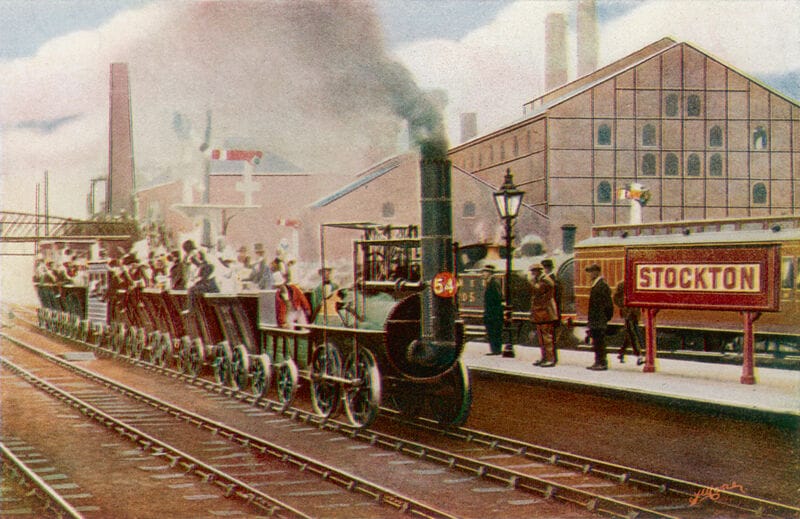
This year sees the 200th anniversary of the UK’s first public rail passenger service driven by steam engines: the Stockton and Darlington Railway, in the north east of England, which began operations in 1825. There had been ‘train’ services before, notably in south Wales from 1807, but those were horse-drawn and were soon superseded in the time of the Industrial Revolution.
Amongst many events to mark the bicentenary, under the Railway 200 banner, BBC Radio 2 has devoted some of its folk music programming to share some newly commissioned songs, all of which tell a story of people connected in some way to the railways. Regular readers will know that I have a huge love for folk music, and in particular for the way it tells stories of everyday life. Many such songs have been handed down through the ages, but this series comprises tunes especially written. There have been five of them, and I thought I’d share three with you, with their background stories. The beautiful thing about these songs and videos is that they were recorded in the presence of the people whose stories had inspired them, so be warned: you may need a tissue handy for a couple of them.
The first one I’m sharing is about a chap called Tom, who is a railway station foundling. The BBC tell us that in 1965, as a two-week old baby, he was found in the ladies’ waiting room of Reading railway station in Berkshire. He had been born out of wedlock to an Irish family, and his birth mother, knowing that she couldn’t bring him up, left him well-dressed and tucked under a bench with a spare nappy and bottle. He was brought up in a loving family home and had a happy childhood, and discovered more about his story much later in his life. He now lives in Nottingham. Singer-songwriters, Chris While and Julie Matthews, from Sheffield in South Yorkshire, are Britain’s longest-enduring female duo having performed together for over 30 years. They have played more than 2,500 gigs and appeared on more than 100 albums, and this is The Waiting Room, the song they wrote for him:
I said tissues might be needed, didn’t I. A beautiful song taking the perspectives of Tom’s birth mother and her regrets at having to leave him, and then his adopted mother and her love for him. Tom and his wife were visibly moved by it.
Regular readers will also know that I am a huge fan of Richard Thompson, possibly the best singer-songwriter this country has ever produced. His song is about a guy called Siggy, who lives in Hampstead, London and is part of the Windrush generation. The 85-year-old came to the UK from Barbados in 1962 and became a railway worker the day he arrived. He still loves his shift in Customer Services at Elstree & Borehamwood station and previously played cricket for the England over-70s, as indeed has one of my old schoolfriends, though more recently than Siggy. This performance of Siggy’s Song offers thanks to Siggy’s teammates at Holtwhites-Trinibis Cricket Club in Enfield, and much fun was had by all:
That is so much fun to watch, and I love the way everyone joins in to honour Siggy. If you don’t know what the Windrush generation is, this page from the official UK Government website gives a good background to it. People like Siggy were hugely important in helping our country to rebuild after the Second World War and they have been treated scandalously.
The final one I’m playing is a real tearjerker. The song is by another of my favourites, Kate Rusby, and tells the story of Charlotte, who was undergoing a mental health crisis and was beside a train track intending to take her own life when David, a train driver, got out of his cab and spoke to her until she felt able to board the train. She later contacted him to say thank you, they started dating and are now married with children, and live near Bradford, West Yorkshire. Light Beyond The Lines tells their story, and is performed by Kate and her husband, Damien O’Kane:
I often hear people say that they don’t like folk music and would much prefer to listen to pop and soul, for example. I think that is very narrow-minded: folk music is real life, it tells stories in a way that no other genre does, and has been the way that we have learned about events for centuries. If you don’t appreciate that I can only say that I’m sorry for you, as you are missing out on so much. I hope these three songs might have opened your eyes and ears a little: had you ever heard the stories before? I hadn’t, and I think they all deserve to be known. Somehow, I don’t think Motown would have worked for them!
I’ll see you again for Song Lyric Sunday, I trust. I’m off to buy a couple of things for my new granddaughter and her parents: they finally left hospital yesterday, and we are all thrilled. I wonder if Kate Rusby could be persuaded to write a song for her…
Take care 🩷

